

Post Graduate Certificate in Data Science and Business Analytics with Generative AI
Transform Your Career with Cutting-Edge Data Skills
- Select live online masterclasses with IIT Guwahati faculty and domain expert-led live sessions
- Get industry-ready with 3 IBM certificates and IBM masterclasses
- Cutting-edge GenAI and business analytics specialisations
- Become a part of the E&ICT Academy, IIT Guwahati Executive Alumni network
Most Advanced Industry-Aligned Curriculum

Choose from Two Cutting-Edge Data Science Specialisations

Accelerate Your Leadership Journey in Data Science and Business Analytics
3x
210K+
35-39%
Programme Overview
In today’s data-driven world, the ability to analyze, interpret, and make data-backed decisions is a must-have skill for professionals. With over 210,000 data science vacancies, the demand for expertise in Python, R, SQL, machine learning, data visualization, and big data has never been greater.
The Post Graduate Certificate in Data Science and Business Analytics by E&ICT Academy, IIT Guwahati, and Emeritus prepares you to thrive in this landscape. Whether you're a technical expert or a non-technical leader, this programme offers hands-on learning to enhance your skills and make data-driven decisions.
Programme Highlights

Gen AI Specialisation
Choose from 2 specialisations including GenAI for Data Science

Live Sessions
Get in-depth insights from select live masterclasses and live online sessions

E&ICT Academy, IIT Guwahati Certificate
Get certified as a data science expert from IITG

3 IBM Certifications
Level up your brand with top industry credentials

GenAI Infused Curriculum
Latest GenAI modules & tools, including ChatGPT-4o

Two Days
Optional Campus Immersion at IIT Guwahati

20+ Tools and Libraries
Delivered via cutting-edge virtual software labs

4 Latest Research Papers
Dive into real-world studies for in-depth insights

10+ Case Studies
Explore multiple case studies and use cases for application-based learning

Two-Week
Capstone Project

20+ Projects
Gets hands-on experience with 20+ data science projects

GitHub and Kaggle
Establish your digital portfolio
Note:
All programme highlights stated here is subject to change as per the discretion of E&ICT Academy, IIT Guwahati or Emeritus.
The immersion will only be conducted with a minimum number of learners signing up.
Domain expert is the programme leader responsible for conducting weekly live sessions.
This programme is taught by both IITG faculty and domain experts. Weekly recorded videos and live online sessions are by domain experts and select live faculty masterclasses are taken by IITG faculty.
Schedule for faculty masterclass will be shared post programme orientation.
How This Programme Gives You the Edge
Post Graduate Certificate in DSBA with Gen AI by E&ICT Academy, IIT Guwahati | Other Outdated/Non-Accredited Technical Certificate Programmes | |
|---|---|---|
Latest Specialisations | Exclusive specialisations in Generative AI in Data Science or Analytics in Business | No specialisations offered |
Highest Number of Tools and Libraries | Access more than 20 most in-demand tools such as R, Python, Power BI, NumPy and ChatGPT | Curriculum covering fewer and outdated tools, with no access to masterclasses and little guidance from domain experts/faculty. |
Recognition of Certificate | Recognised certificate from E&ICT Academy, IIT Guwahati along with 3 IBM certificates | Certification from non-accredited institutes. Limited/No professional certification. |
Getting Started with Kaggle and GitHub Portfolio | Learn how to build your GitHub portfolio and use Kaggle to apply data science skills, become industry ready, and solve real world problems. | No guidance for personal brand building |
Who is this Programme for?
This programme is designed for professionals who want to leverage data and machine learning (ML) to gain a competitive edge. This programme will equip you with the skills and knowledge to succeed in today's data-driven world.
Specifically, this programme is ideal for:
Data Analysts and Business Analysts: Looking to transition into data science roles or enhance their analytical skills
Tech Professionals: Aiming to apply data science techniques to solve real-world problems
By the end of this program, you will be able to:
Master Data Science Fundamentals: Gain a solid understanding of statistical concepts, data cleaning, and data visualisation.
Leverage Data and Machine Learning: Apply advanced techniques, such as predictive modelling, natural language processing, and ML, to extract valuable insights from data.
Use Generative AI: Learn how to use AI to generate creative content, automate tasks, and enhance decision-making.
Drive Business Impact: Use data-driven insights to optimise business operations and improve customer experiences.
Advance Your Career: Position yourself as a valuable asset in a data-driven economy.
Eligibility criteria for this programme:
Minimum graduate/Diploma Holder (10+2+3) in any discipline
Basic Math and programming knowledge preferred
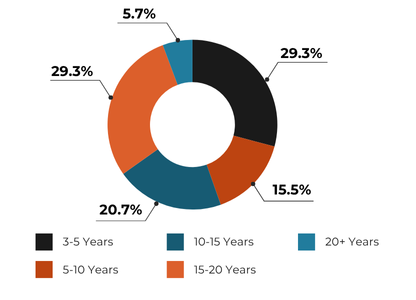
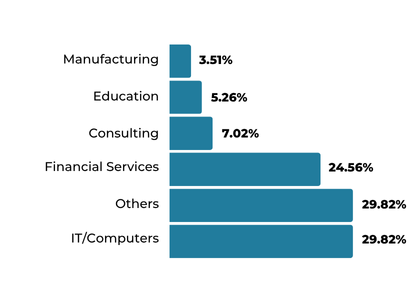
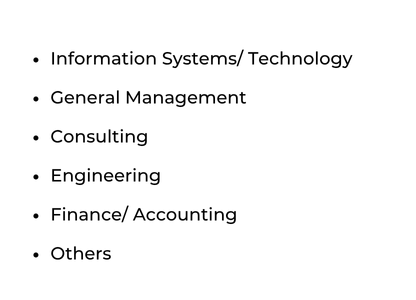
Seasoned Learners from Diverse Industries
Work Experience Summary
Industry Distribution Summary
Function Wise Summary
Programme Modules
Preparatory Session
Building Your GitHub Profile & Publishing Projects
Module 1: Math/Stats for Data Science
An introduction to linear algebra
Basic probability and statistics
Descriptive statistics and distributions
Hands-on exercises with descriptive statistics in R
Working with real-world data to calculate mean, median, and variance
Module 2: Data Analysis using R
An introduction to R and RStudio
Basic data manipulation in R (dplyr, tidyr)
Data visualisation in R (ggplot2)
Hands-on data manipulation and visualisation in R
Data summarisation and plotting using real datasets in R
Module 3: Data Cleaning
An introduction to data cleaning
Handling missing data
Detecting and managing outliers
Hands-on data cleaning with Python or R
Working with messy data: cleaning, transforming, and preparing for analysis
Module 4: SQL Basics
Installation of MYSQL basic terms: database, tables, records, columns, and data types in MYSQL
Types of commands in MYSQL: DDL, DML, TCL, DCL, and DQL
Module 5: Constraints in SQL
Types of Constraints in MYSQL
Creating tables using the constraints to maintain data integrity
Module 6: Joins in SQL
Different types of joins in MYSQL
Combining multiple tables using various joins
Module 7: Functions in SQL
Various aggregation functions: Sum, Max, Min, Average, and Count
Aggregation functions with commands such as where, group by, and having
Module 8: Data Visualisation using Power BI
Focus on the interface of Power BI Desktop and importing data in Power BI
Data visualisation using various visuals, such as line chart, bar chart, pie chart, map chart, table, card, and slicer
Module 9: Power Query
Removing null values, duplicate records, error from data, and changing data types if required
Merging and appending data from various sources
Module 10: Data Modelling and DAX
Difference between Calculated Column and Measure; various DAX Formulas
DAX functions and data modelling
Module 11: Publishing BI Reports
Creating roles in Power BI Desktop to maintain row-level security
Publishing the report on Power BI services, and assigning access to different people as per roles
Module 12: Data Storytelling
Essentials of story telling
Presenting report by using the art of story telling
Module 13: Python Fundamentals
The installation of Python notebook and basics of Python
Datatypes, typecasting, expressions and variables, and string operations
Module 14: Data Engineering Basics
Loading data with open and writing data with open
Handling data in Python using Pandas and doing transformation
Module 15: Data Science Using Python Packages (Part 1)
An introduction to Python for data science
An overview of NumPy
An introduction to Pandas
Hands-on exercises with NumPy and Pandas
Data manipulation exercises
Working with arrays, series, and DataFrames
Module 16: Data Science using Python packages (Part 2)
Advanced Pandas operations
An introduction to Matplotlib and Seaborn for data visualisation
Data visualisation with Matplotlib and Seaborn
Advanced Pandas use cases
Module 16: Exploratory Data Analysis (EDA)
An introduction to EDA
Handling missing data
Outliers detection
Data summarisation techniques
EDA on a real dataset
Visualising distributions and correlations
Creating summary statistics using Python
Module 18: Inferential Statistics (Part 1)
Probability distributions
Normal distribution
Binomial distribution
Other common distributions (Poisson, Exponential, etc.)
Hypothesis testing basics
Null hypothesis vs. Alternative hypothesis
P-value and statistical significance
Type I and Type II errors
Confidence intervals
Constructing and interpreting confidence intervals
Margin of error
Module 19: Inferential Statistics (Part 2)
Statistical tests
Z-test and T-test
ANOVA (Analysis of Variance)
One-way and Two-way ANOVA
Chi-Squared Test
Chi-Squared Test for Independence
Chi-Squared Test for Goodness of Fit
Correlation vs. Causation
Understanding Correlation
Differentiating between Correlation and Causation
Conducting Hypothesis Testing in Python
Implementing tests using Python libraries (e.g., SciPy and Statsmodels)
Practical examples with real data
Statistical tests and case studies
Applying various statistical tests
Interpreting results and drawing conclusions
Working on case studies requiring inferential statistics
Module 20: Predictive Modelling
An introduction to predictive modeling
Steps in building predictive models
An introduction to regression models (Linear, Logistic, and more)
Implementing regression models in Python
Evaluating model performance (R-squared, MSE, etc.)
Module 21: Machine Learning Fundamentals
Introduction to Machine Learning
Supervised vs Unsupervised learning
An overview of algorithms (KNN, Linear Regression)
Building simple ML models using Scikit-Learn
Data preparation and feature selection for ML models
Module 22: Machine Learning Fundamentals (Supervised Learning - Part 1)
Linear Regression
Decision Trees
Overfitting and regularization
Implementing Linear Regression and Decision Trees
Evaluating model performance using cross-validation and metrics such MAE and RMSE
Module 23: Machine Learning Fundamentals (Supervised Learning - Part 2)
Support Vector Machines (SVM)
Random Forest
Hands-on with SVM and Random Forest models
Module 24: Machine Learning Fundamentals (Unsupervised Learning)
Introduction to clustering (K-means, Hierarchical)
Dimensionality Reduction (PCA)
Applications of unsupervised learning
Implementing clustering algorithms in Python
Visualising clusters and evaluating cluster quality
Module 25: Hyper Parameter Tuning and Model Preservation
GridSearch and RandomisedSearch
Model persistence with joblib and pickle
Model optimisation techniques
Hyperparameter tuning with Python (using Scikit-Learn)
Saving and loading models
Working on performance improvements with tuning
Module 26: Time Series Forecasting
Time series components (trend, seasonality, etc.)
ARIMA, SARIMA, and other forecasting methods
Stationarity in time series
Implementing ARIMA and SARIMA models in Python
Working with time series data (real-world datasets)
Evaluating forecast accuracy
Module 27: Ensemble Modelling
An introduction to ensemble methods
Bagging, boosting, and stacking
Introduction to XGBoost
Working of XGBoost
Implementing ensemble models (Bagging, Boosting)
Case study on ensemble model performance
Module 28: Association Rule Mining
Introduction to association rules
Apriori algorithm
Applications of association rules in market basket analysis
Implementing the Apriori algorithm in Python
Hands-on project for mining association rules using a dataset (e.g., transactional data)
Module 29: Supply Chain Analytics
Introduction to Supply Chain Analytics
Key metrics (Lead Time, Inventory Turnover, etc.)
Demand Forecasting
Working with supply chain datasets
Implementing demand forecasting models (e.g., time series)
Module 30: Marketing Analytics
Introduction to Marketing Analytics
Customer Segmentation
Customer Lifetime Value (CLV) Analysis
Segmentation techniques using clustering
Hands-on with Customer Lifetime Value models
Module 31: Finance and Risk Analysis
Introduction to Finance Analytics
Case studies on financial data analysis
Risk assessment using historical data and financial ratios
Risk Analysis Overview
Financial Metrics and Ratios (ROI, NPV, etc.)
Module 32: Specialisations
Specialise in one of 2 domains:
Generative AI for Data Science
Analytics for Business
Module 33: Capstone Project
A 2-week project
IIT Guwahati Faculty Masterclasses
Learn advanced technical concepts and practical applications through live masterclasses conducted by top IIT Guwahati faculty.
Note:
All programme curriculum stated here is subject to change as per the discretion of E&ICT Academy, IIT Guwahati and Emeritus
More than 20 Tools and Libraries Covered for Practical Applications





Note:
Programme learning hours might change due to unavoidable circumstances, and revised details will be provided closer to the programme start date.
The list of tools covered is not exhaustive. Revised details will be provided closer to the programme start date.
All product and company names are trademarks or registered trademarks of their respective holders, and their use does not imply any affiliation with or endorsement by them.
Tools will be provided via virtual labs for learning, as per the curriculum. Access will be given when the respective modules are taught.
Solve Real-World Problems with Exclusive Agentic AI Masterclasses
Module 1: Building Intelligent Agents
What is Agentic AI? Trends & Industry Context
Agent Lifecycle (Perception → Reasoning → Action)
Autonomy Spectrum & Agent Types
Core Components: Tool Use, Memory, Planning, Multi-Agent Collaboration
Architecting an Agent (Single vs Multi-Agent, Hybrid)
Basics of RAG (Retrieval-Augmented Generation)
Ecosystem Tools (LangChain, Autogen, CrewAI, Flowise, Vector DBs)
Live Demo: Simple Planner Agent
Module 2: Deployment, Learning & Responsible AI
Embedding Models & Agent Memory
Vector Search & Chunking Strategies
Advanced RAG Architectures & Tuning
Learning & Adaptation (Reinforcement Learning, Human Feedback)
Deployment Options (Cloud, Serverless, Embedded)
Monitoring & Observability (LangSmith)
Responsible Agentic AI (Risks, Bias, Privacy, Safety Layers)
Industry Case Studies & Future Trends
Interactive Design Exercise: Architect Your Own Agent
Note:
* The Agentic AI masterclass schedule and curriculum is subject to change as per the discretion of Emeritus
Gain Credentials from IBM, a Pioneer in Data Science Technology
SQL and Relational Databases 101
Module 1: SQL and Relational Databases 101
Module 2: Relational Model Constraints and Data Objects
Module 3: Data Definition Language (DDL) and Data Manipulation Language (DML)
Module 4: Advanced SQL
Module 5: Working with multiple tables
Python for Data Science
Module 1: Python Basics
Module 2: Python Data Structures
Module 3: Python Programming Fundamentals
Module 4: Working with Data in Python
Module 5: Working with NumPy Arrays and Simple APIs
Prompt Engineering for Everyone
Module 1: An Introduction to Prompt Engineering
Module 2: Getting Started with Prompt Engineering
Module 3: The Chain-of-Thought Approach
Module 4: Advanced Techniques
Module 5: Final Project
Note:
All programme curriculum stated here is subject to change as per the discretion of E&ICT Academy, IIT Guwahati, Emeritus, or IBM.
More than 20 Projects & Cases for Hands on Learning

Sales Analysis Dashboard:
Build a dashboard to analyze customer orders, including total orders, sales by product category, customer segmentation, and monthly sales trends.
Skills Gained: Power BI, Power Query, and DAX

Employee Churn:
Analyze employee attrition factors, identify retention risks, build predictive models to forecast attrition, and deliver actionable insights to optimize HR strategies and decision-making.
Skills Gained: Data preprocessing and cleaning, statistical analysis and modeling, machine learning implementation, data visualization skills, and feature engineering techniques.

Customer Segmentation:
Learn how to apply clustering algorithms (K-Means, Hierarchical), analyze clusters, and make business decisions based on cluster characteristics.
Skills Gained: Clustering techniques, unsupervised learning, customer segmentation, data preprocessing.

House Price Prediction:
Develop a predictive model to estimate house prices based on multiple features using regression techniques.
Skills Gained: Regression modeling, evaluation metrics (MSE, R-squared), feature engineering, and data preprocessing.
Customer Experience Prediction:
Identify satisfaction drivers, analyze data to distinguish satisfied from neutral/dissatisfied responses, develop predictive models, and extract actionable insights to enhance customer experience.
Skills Gained: Data cleaning and preparation, statistical analysis techniques, machine learning model development, feature engineering, and data visualization.

Time Series Forecasting:
Analyze historical sales data to forecast future trends using time series analysis methods. Understand time series data, build forecasting models, evaluate accuracy, and interpret patterns in time series data.
Skills Gained: Time series forecasting, ARIMA models, data visualization, trend analysis.
Note:
All programme projects stated here is subject to change as per the discretion of E&ICT Academy, IIT Guwahati and Emeritus
Choose from Two High-Impact Data Science Specialisations
Generative AI in Data Science
Module 1: Introduction to Generative AI for Data Science
Module 2: Prompt Engineering for Data Science Use Cases
Module 3: Generative AI in Data Science Workflows
Analytics in Business
Module 1: Web Analytics
Module 2: Retail Analytics
Module 3: Real-World Case Studies in Data Science
Note:
The topics and schedule of specialisations may be changed depending on whether a minimum number of learners have opted for a specialisation
Programme Certificate
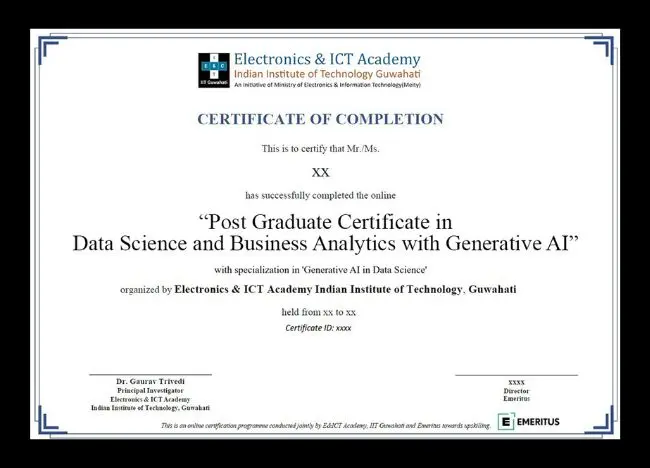
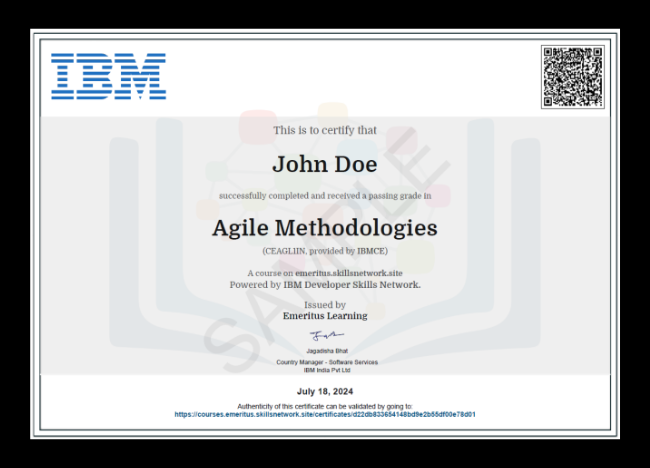
Notes:
Specialisations will be mentioned in the programme certificate for learners to showcase
All certificate images are for illustrative purposes only and may be subject to change at the discretion of E&ICT Academy, IIT Guwahati and IBM
To receive the completion certificate, participants must score a minimum of 70% overall on mandatory assignments and successfully complete the capstone project
Learn from Renowned IIT Guwahati Faculty

Dr. Hanumant Singh Shekhawat
Associate Professor at the Department of Electronics and Electrical Engineering
- Ph.D. Degree in Applied Mathematics from University of Twente, Netherlands
- M.Tech. Degree in Electrical Engineering from IIT Bombay
Dr. Hanumant Singh Shekhawat is an Ass...
Note:
Programme faculty are subject to change at the discretion of IIT Guwahati and Emeritus.
Emeritus Career Services Benefits
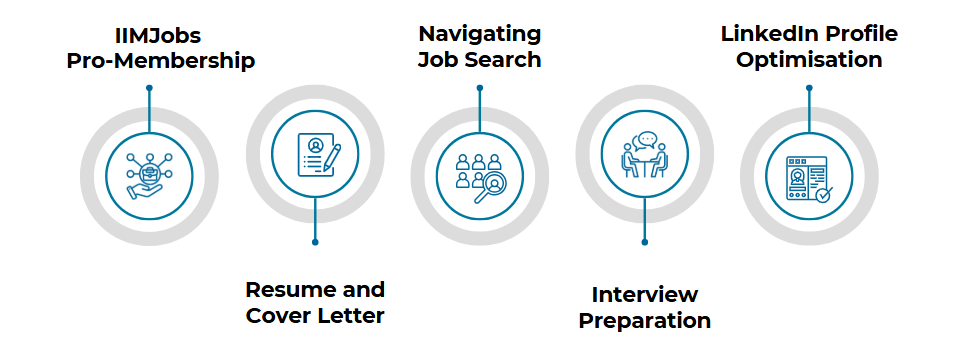
15 recorded sessions and resources in the above categories
Pro-membership and features of IIMJobs and Hirist: Access to job insights recruiter action status, follow-up actions, and ability to chat with recruiters who have shortlisted your profile
Spotlight on IIMJobs and Hirist: Profile boost for applied jobs (that align with acquired certification), greater profile visibility - highlighted with institute name along with a testimony of certificate acquisition by the candidate
Spotlight Plus: All the benefits of Spotlight and added advantages like profile and rank boost in the recruiter search database
Resume builder tool: 6-month access to DIY resume builder, auto resume creator, optimization suggestions based on key parameters, guide on information to be incorporated, and unlimited resume iterations within the duration
Notes:
These sessions are not live.
E&ICT Academy, IIT Guwahati or Emeritus do NOT promise or guarantee a job or progression in your current job. Career Services are only offered as a service that empowers you to manage your career proactively. The Career Services mentioned here are offered by Emeritus. E&ICT Academy, IIT Guwahati is NOT involved in any way and makes no commitments regarding the Career Services mentioned here.
This service is available only for Indian residents enroled into select Emeritus programmes.
What is the E&ICT Academy, IIT Guwahati Post Graduate Certificate in Data Science and Business Analytics with Gen AI?
The E&ICT Academy, IIT Guwahati Post Graduate Certificate in Data Science and Business Analytics with Gen AI is a specialised data science course that covers Python for data science, statistics and data science, machine learning, and generative AI. This data science certification course is designed for professionals looking to enhance their expertise in AI, analytics, and business intelligence.
What are the eligibility criteria for this data science course?
The data science course eligibility requires candidates to have a bachelor’s degree in any discipline. While prior knowledge of programming or statistics is beneficial, it is not mandatory. Professionals from IT, engineering, business, and finance backgrounds can apply.
What is the duration and fee structure of the programme?
The data science course duration is 10 months. The data science course fees are ₹1,32,000+GST, covering tuition, course materials, and mentorship from IIT Guwahati faculty. The programme provides a cost-effective alternative to an online data science master’s degree.
What skills are required to be a data scientist?
The key skills required to be a data scientist include expertise in Python for data science, machine learning, big data analytics, and generative AI. The programme equips learners with hands-on experience in AI-driven decision-making and business analytics.
Does this data science course include hands-on training?
Yes, this programme provides hands-on learning through live sessions, case studies, real-world projects, and practical assignments. The programme gives you access to 20+ most-in demand data science tools, which will be taught in cutting-edge virtual integrated labs. The programme is an excellent choice for those looking for a data science and analytics course with industry applications.
Is this a data science course with placement support?
While the programme does not guarantee placements, it offers career support services such as resume-building workshops, industry mentorship, and job referrals, making it one of the best data science courses for professionals seeking career advancement.
What are the career opportunities after completing this programme?
Graduates can pursue roles such as Data Scientist, Business Analyst, AI Specialist, Data Engineer, and more. This certification programme is ideal for professionals aiming to enhance their qualifications through a data science and AI course.
How does this programme compare to an online data science master’s degree?
While an online data science master’s degree is broader in scope, this Advanced Certification Programme in Data Science and Business Analytics with Gen AI is a time-efficient and industry-focused alternative, making it a strong choice for working professionals.
Why should I choose this E&ICT Academy, IIT Guwahati Data Science Programme?
This programme is one of the best online data science courses, combining the expertise of E&ICT Academy, IIT Guwahati with the latest advancements in data science and generative AI. With hands-on training, expert faculty, and a prestigious certification, it is an ideal programme for anyone looking to advance in AI and data science.
Early registrations are encouraged. Seats fill up quickly!
Flexible payment options available.
Starts On