


Post Graduate Certificate in Artificial Intelligence and Machine Learning
Make a big move in the world of AI
- Select live online masterclasses with IIT Guwahati faculty
- Dual specialisation (Choose from five latest AI and ML specialisations)
- Get industry-ready with 3 IBM certificates and IBM masterclasses
- Become a part of the E&ICT Academy, IIT Guwahati Executive Alumni network
- Exclusive Agentic AI live masterclasses by domain expert
- Domain expert-led live sessions for industry-relevant learning
Most Advanced Industry-Aligned Curriculum

Choose from Five Cutting-Edge AI and ML Specialisations

Step Into Success with a Career in AI and ML
10x
4x
51%
Programme Overview
In today's competitive landscape, AI and ML expertise is in high demand, with over 213,000 job openings for roles requiring skills such as Natural Language Processing, Neural Networks, Pattern Recognition, and Generative AI.
The Post Graduate Certificate in Artificial Intelligence and Machine Learning by E&ICT Academy, IIT Guwahati is crafted for professionals eager to harness these advanced capabilities to drive innovation and solve complex challenges. Whether you’re a technical expert aiming to deepen your skillset or a non-technical leader looking to understand AI's transformative potential, this programme equips you with the first mover advantage into an industry that is on the cusp of exponential growth.
Programme Highlights

Dual Specialisations
Choose from five advanced specialisations

Live Masterclasses
Select live online masterclasses by IIT Guwahati faculty

Live Sessions
Hands-on industry-relevant learning sessions by domain expert

E&ICT Academy, IIT Guwahati Certificate
Get certified as an AI and ML expert from E&ICT Academy, IITG

3 IBM Certifications
Level up your brand with top industry credentials

Two Days
Optional Campus Immersion at IIT Guwahati

25+ Tools and Libraries
Delivered via cutting-edge virtual integrated labs

6 Latest Research Papers
Dive into real-world studies for in-depth insights

30+ Cases
Explore multiple use cases for application-based learning

Two-Week
Capstone Project

20+ Projects
Gets hands-on experience with 20+ AI and ML projects

GitHub and Kaggle
Establish your digital portfolio
Note:
All programme highlights stated here is subject to change as per the discretion of E&ICT Academy, IIT Guwahati or Emeritus.
The immersion will only be conducted with a minimum number of learners signing up.
Domain expert is the programme leader responsible for conducting weekly live sessions.
This programme is taught by both IITG faculty and domain experts. This programme is taught by domain expert through live sessions. There will be weekly recorded videos. Select live faculty masterclasses are taken by IITG faculty.
Schedule for faculty masterclass will be shared post programme orientation.
How This Programme Gives You the Edge
Post Graduate Certificate in AI and ML by E&ICT Academy, IITG | Other Outdated/Non-Accredited Technical Certificate Programmes | |
|---|---|---|
Specialisations | Gain exclusive dual specialisations out of Cybersecurity, No-Code, Cloud Computing, IoT, and XAI | No specialisations offered |
Highest No. of Tools & Libraries | Access 25+ AI and ML tools & libraries including latest GenAI tools such as Mistral, giving you hands-on learning with the most-widely used applications. | Curriculum covering fewer and outdated tools, with no access to virtual labs/masterclasses and little guidance from domain experts/faculty |
Recognition of certificate | Certificate from E&ICT Academy, IIT Guwahati and 3 IBM professional certifications that instantly add credibility to your resume | Low or no certification; usually from non-accredited institutes |
Get Started with Kaggle and GitHub Portfolio | Learn how to build your own GitHub and Kaggle portfolio to stand apart from the crowd, become industry ready, and solve real world problems. | No guidance for personal brand building |
Who is this Programme for?
This programme is designed for professionals seeking to harness the power of AI and ML to drive innovation and solve complex problems. Whether you're a technical professional looking to deepen your expertise or a non-technical leader aiming to understand AI's potential, this programme is tailored to your needs.
Specifically, this programme is ideal for:
Data Scientists and Data Analysts: Looking to advance their skills in cutting-edge AI and ML techniques and tools
Software Engineers: Seeking to transition into AI/ML roles or enhance their existing projects with AI capabilities
Business Analysts and Consultants: Aiming to leverage AI to drive data-driven insights and decision-making
Product Managers and Product Owners: Interested in incorporating AI/ML into product development and strategy
By the end of this programme, you'll be equipped to:
Lead AI/ML initiatives: Drive innovation and solve complex business problems
Make data-driven decisions: Use AI to extract meaningful insights from data
Collaborate with AI/ML teams: Effectively communicate with data scientists and engineers
Stay ahead of the curve: Keep up with the latest advancements in AI and ML
Candidates must meet the following criteria to enroll in this programme:
Minimum Graduate/Diploma Holder (10+2+3) in any discipline
Basic Math and programming knowledge required
Seasoned Learners from Diverse Industries
Work Experience Summary
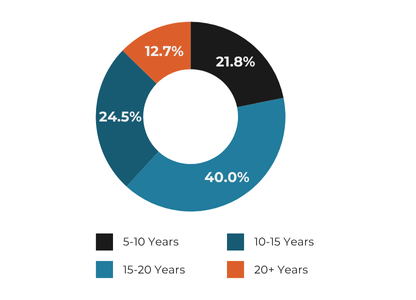
Industry Distribution Summary
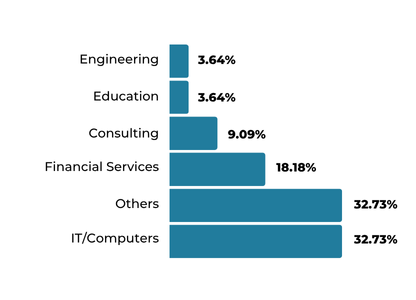
Function Wise Summary
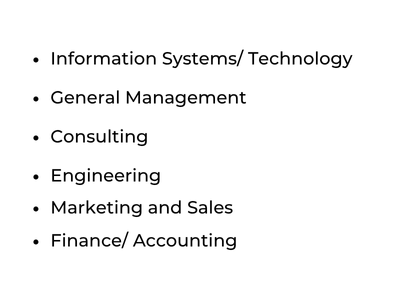
Programme Modules
Python Preparatory Session
Programming is Just Logic – Anyone Can Do It
Module 1: Introduction to Data Science
What is data science, history, learning path, why to learn it, its impact and its scope
Participants sharing their Data Science journey, and where they are and what they do
What do participants anticipate about data science and its scope?
Module 2: Mathematics and Statistics Fundamentals
Vectors, Scalars, Matrix, Operations on Matrix, Determinants, Role of stats in DS, Types of data, Descriptive Stats, Intro to Probability, and Probability Distributions
Inferential Statistics, Sampling, Estimation, Hypothesis, Type 1 and Type II errors, Z test, T test, Z score, and Confidence Interval
Module 3: Python Fundamentals
Python basic Data Structures, Lists, Tuples, Sets, Dictionaries, Functions, and Loops
Control Structures, File Handling, Comprehensions OOPs, Generators, and Libraries
Module 4: Data Analysis & Git Fundamentals
Excel based (Importing, Grouping, Pivots), SQL based (Aggregation), Git Fundamentals, Collaboration and Version Control
Python for Data science (Numpy, Pandas, Matplotlib, SciPy, Scikit-learn, etc.)
Module 5: Data and Feature Engineering
Data cleaning, feature selection, and normalization
Hands-on exercises, case studies, and discussions
Module 6: Supervised Learning - Regression
Linear regression and evaluation metrics
Multiple, Polynomial, Overfitting, Solution to Over Fitting
Module 7: Supervised Learning - Classification
Evaluation metrics
Logistic regression, Decision tree, Random Forest, SVM, Model Deployment basics (store, load, predict)
Module 8: Unsupervised Learning
Basics, Distance Matrix and Applications
How to implement clustering (Agglomerative clustering) and connect with business requirements, Algorithms (PCA, CFA), Association Rule Mining, Algorithm, DB Scan, Anomaly Detection (Nearest Neighbor, and Isolation Forest)
Module 9: Ensemble Modelling
Ensemble technique with examples (its difference from supervised and unsupervised learning); types (Bagging and boosting )
Bagging and boosting, different algorithms and libraries (Adaboost, GB, XGB, Catboost)
Module 10: Time Series Modelling
Types of timeseries data, AR and MA Modelling
ARIMA, FB Prophet, and implement data
Module 11: Recommendation Engine
Similarities - how to measure (PSN correlation, Cosine), Distances (Manhattan, Euclidean), and Use cases
What is recommendation engine, its purpose, types and how to build (libraries)
Module 12: Model Evaluation and Deep Learning Fundamentals
Cross-validation, neural networks, activation functions, and DL frameworks
Cross-validation, neural network coding, and applications
Module 13: Neural Network Basics
Perceptrons, the math behind perceptrons, and Python implementation
Introduction to MLPs, forward propagation, Python implementation, introduction, math derivation, and Python implementation
Module 14: Deep Learning Optimisation
Introduction to optimisers, activation functions, loss functions and overfitting scenario
Best practices in choosing optimizers, activation functions, loss functions, batch normalisation and dropout technique
Module 15: Convolution Neural Networks
Convolution Neural Network (Filters - Feature Detectors, Pooling - Avg, Max, Padding and Stride), Basic Architecture
Pre-trained Networks, Transfer Learning and Fine Tuning
Module 16: Recurrent Neural Networks
Recurrent Neural Networks (Temporal Nature of Data, Recurrent Mechanism, Types of RNN), LSTM Gates, and GRU Gates
Applications, Drawbacks of RNN, LSTM and its drawbacks, GRU, Attention Mechanism, and Transformers
Module 17: Unsupervised Learning Advanced
Autoencoders, DBN, and RBM
Applications of networks for various use cases
Module 18: Generative AI
VAE, GAN, Architecture, Training Process of Generator and Discriminator, DCGAN, WGAN and other GANs, Introduction, and sequence generation
Implementation and application
Module 19: Natural Language Processing
Introduction to NLP, Text Preprocessing, Text Tokenisation, and Word Embeddings
Text Classification, Use of Sequence models (RNN, LSTM, GRU), NER, Information Extraction, and Machine Translation
Module 20: Transformers
Introduction, Transformer architecture, Attention Mechanism, and types (GPT, BERT, T5, etc.)
Machine Translation and Text Generation
Module 21: Computer Vision
Basic image processing techniques, image scaling, object detection algorithms, and image segmentation algorithms
Video analysis, self-supervised learning techniques, and few shot learning
Module 22: Speech Recognition
Basics of speech recognition, history, importance and applications
Fundamentals of speech signals, feature extraction (MFCC, spectrogram), Speech Classification, Introduction to Speech Transcription (HMM, ASR models), and TTS systems
Module 23: Reinforcement Learning
Introduction to RL, History, key concepts, applications, case studies, Markov Decision Process, Dynamic Programming (Bellman Equations, Policy Evaluation and Improvement)
Monte Carlo Methods, Temporal Difference Learning, Q learning and its implementation
Module 24: Deep Reinforcement Learning
Integration of Deep Learning in RL, Multi-agent RL, hierarchical RL, meta-RL, practical applications
Neural networks in RL, DQN Architecture and its implementation, Policy Gradient Methods
Module 25: Large Language Models
LLM - definition, Pretraining objectives, fine-tuning, transfer learning, prompt engineering, applications, Other LLMs, and Embedding
Prompt Engineering, Agents, and Vector DBs
Module 26: REST API
REST API concept, POST, GET, PUT, and DELETE
Routing Applications
Module 27: Streamlit
Introduction to Streamlit, Text, and Widgets
Building application on Streamlit
Module 28: Deployment of ML Ops
Ethical considerations (banking, ecommerce sectors); pushing code to repository
Responsible AI; Explainable AI; Registry, Model & Data Monitoring
Specialisations
Learners get to choose 2 out of 5 specialisation options.
Cybersecurity
Cloud Computing
No-Code
Internet of Things (IoT)
Explainable AI (XAI)
Capstone Project
2 Week Capstone Project
Note:
All programme curriculum stated here is subject to change as per the discretion of E&ICT Academy, IIT Guwahati or Emeritus.
More than 25 Practical Tools and Libraries Covered



Note:
Programme learning hours might change due to unavoidable circumstances, and revised details will be provided closer to the programme start date.
The list of tools covered is not exhaustive. Revised details will be provided closer to the programme start date.
All product and company names are trademarks or registered trademarks of their respective holders, and their use does not imply any affiliation with or endorsement by them.
Tools will be provided via virtual labs for learning, as per the curriculum. Access will be given when the respective modules are taught.
Solve Real-World Problems with Exclusive Agentic AI Masterclasses
Module 1: Building Intelligent Agents
What is Agentic AI? Trends & Industry Context
Agent Lifecycle (Perception → Reasoning → Action)
Autonomy Spectrum & Agent Types
Core Components: Tool Use, Memory, Planning, Multi-Agent Collaboration
Architecting an Agent (Single vs Multi-Agent, Hybrid)
Basics of RAG (Retrieval-Augmented Generation)
Ecosystem Tools (LangChain, Autogen, CrewAI, Flowise, Vector DBs)
Live Demo: Simple Planner Agent
Module 2: Deployment, Learning & Responsible AI
Embedding Models & Agent Memory
Vector Search & Chunking Strategies
Advanced RAG Architectures & Tuning
Learning & Adaptation (Reinforcement Learning, Human Feedback)
Deployment Options (Cloud, Serverless, Embedded)
Monitoring & Observability (LangSmith)
Responsible Agentic AI (Risks, Bias, Privacy, Safety Layers)
Industry Case Studies & Future Trends
Interactive Design Exercise: Architect Your Own Agent
Note:
The Agentic AI masterclass schedule and curriculum is subject to change as per the discretion of Emeritus
Gain Credentials from IBM, a Pioneer in AI and ML Technology
Deep Learning with TensorFlow
Introduction to TensorFlow
Convolutional Neural Networks (CNN)
Recurrent Neural Networks (RNN)
Unsupervised Learning
Autoencoders
Build Your Own Chatbot
Introduction to Chatbots
Working with Intents
Working with Entities
Defining the Dialog
Deploying your Chatbot
Advanced Concepts – Part 1
Advanced Concepts – Part 2
PyTorch: Tensor, Dataset and Data Augmentation
Overview of Tensors
Tensors 1D
Two-Dimensional Tensors
Derivatives in PyTorch
Simple Dataset
Dataset and Data Augmentation
Note:
All programme curriculum stated here is subject to change as per the discretion of E&ICT Academy, IIT Guwahati, Emeritus, or IBM.
More than 30 Projects and Cases for Practical Applications

Predicting corporate bankruptcy/Personalised chemotherapy
Applying data science to predict financial risks and personalize cancer treatments.

Application of Statistics in real-world examples
Using statistics to interpret data and make informed decisions.
How Python is used in various industries
Exploring Python applications in finance, healthcare, and technology.

Real-world data analysis and version control with Git
Using Git for tracking changes and collaboration in data projects.

Examining historical Titanic data to understand passenger behaviors and predict survival
Creating features to enhance the accuracy of survival predictions.

How regression is applied in various industries
Applying regression techniques to predict trends and behaviors.
Analyzing loan data to identify default risk
Building models to predict loan defaults based on borrower characteristics.

Spam detection: Identifying spam messages
Developing models to classify messages as spam or not in extensive datasets.

Clustering and anomaly detection in various industries
Grouping data and identifying anomalies without labeled data.
MNIST Digit Classification: Classifying handwritten digits
Developing models to accurately identify digits in image datasets.
Note:
All programme projects stated here is subject to change as per the discretion of E&ICT Academy, IIT Guwahati and Emeritus
Choose from Five High-Impact AI and ML Specialisations
Cybersecurity
Introduction to Cybersecurity
Roles and responsibilities in Cybersecurity
Key companies in Cybersecurity
Types of Cybersecurity Threats
Cybersecurity Frameworks and Standards
Technical aspects of Cybersecurity
Relevance of AI in Cybersecurity
Recent AI developments in Cybersecurity
AI use cases in Cybersecurity
Challenges and ethical concerns in AI for Cybersecurity
Future of AI in Cybersecurity
Cloud Computing
Introduction to Cloud Computing
Roles and responsibilities in Cloud Computing
Key Cloud Computing Service Models
Types of Cloud Deployments
Key companies in Cloud Computing
Cloud Computing services and offerings
Technical aspects of Cloud Computing
Relevance of AI in Cloud Computing
Recent AI developments in Cloud Computing
AI use cases in Cloud Computing
Future of AI in Cloud Computing
No-Code
Introduction to No-Code AI
What people in No-Code AI do
Key platforms in No-Code AI (e.g., Google AutoML DataRobot, H2O.ai)
Overview of services provided by No-Code AI platforms
Benefits of using No-Code AI (speed, accessibility, reduced technical complexity)
Limitations of No-Code AI (customization, scalability)
Technical aspects of No-Code AI tools (drag-and-drop interfaces, automated model building, and deployment)
How AI is integrated into No-Code platforms
Recent developments in No-Code AI
AI use cases enabled by No-Code AI platforms industries adopting No-Code AI (finance, healthcare, retail, etc.)
Ethical concerns and challenges in No-Code AI
Future trends in No-Code AI (democratisation of AI, citizen data scientists)
Internet of Things (IoT)
Introduction to AI and ML in IoT
Key IoT devices and their role in AI and ML data collection
IoT data processing and management for AI models (Edge vs. Cloud)
AI Models for IoT (Predictive Models, Anomaly Detection, Classification)
Machine learning algorithms used in IoT (Regression, Decision Trees, Neural Networks)
Real-Time Data Analytics in IoT using AI and ML
AI at the Edge: Challenges and Opportunities
AI Use Cases in IoT (Predictive Maintenance, Smart Cities, Connected Vehicles)
Deep Learning in IoT: Use Cases and Frameworks
IoT Data Labelling for AI and ML Models
AutoML for IoT Applications
AI-Driven automation in IoT Systems
Challenges of AI and ML integration in IoT (Data Quality, Privacy, Real-Time Processing)
Future trends in AIML for IoT (Federated Learning, 5G, AIoT)
Explainable AI (XAI)
Introduction to Explainable AI (XAI)
Importance of Explainability in AI
Roles in Explainable AI (Data Scientists, AI Ethicists, Domain Experts)
Key companies working on Explainable AI (e.g., Google, IBM, Microsoft)
Services provided by Explainable AI platforms
Techniques for Explainable AI (LIME, SHAP, Saliency Maps, Integrated Gradients)
Challenges in Explainable AI (complexity, transparency vs. accuracy tradeoff)
How AI systems can be made explainable
Recent developments in Explainable AI
AI use cases where explainability is crucial (Healthcare, Finance, Legal, Autonomous Systems)
Regulatory and ethical implications of Explainable AI
Future trends in Explainable AI (regulation, democratization of explainability tools)
Note:
The topics and schedule of specialisations may be changed depending on whether a minimum number of learners have opted for a specialisation
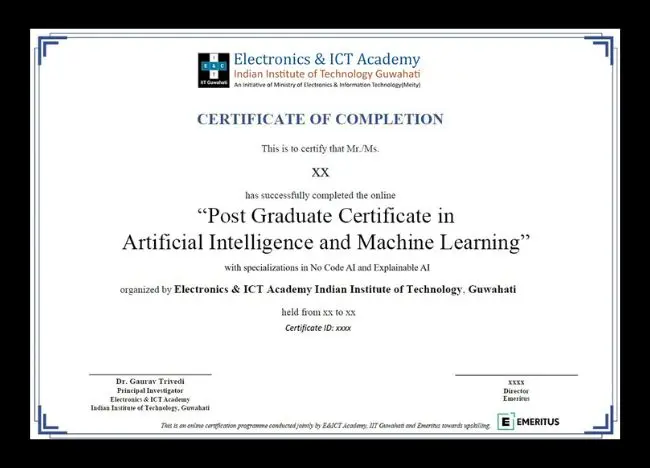
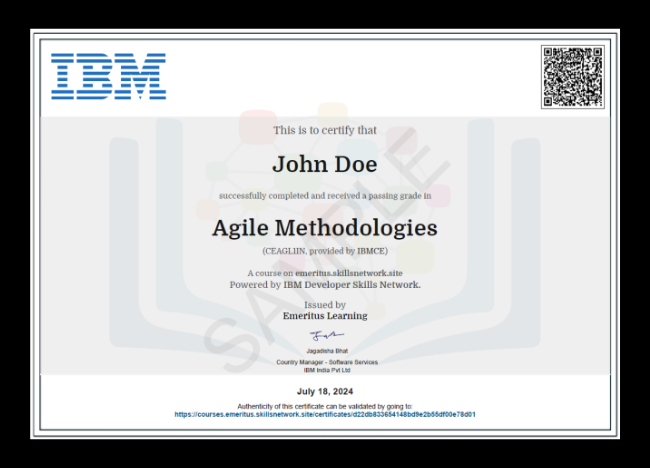
Programme Certificate
Note:
Specialisations will be mentioned in the programme certificate for learners to showcase.
All certificate images are for illustrative purposes only and may be subject to change at the discretion of E&ICT Academy, IIT Guwahati and IBM.
To receive the completion certificate, participants must score a minimum of 70% overall on mandatory assignments and successfully complete the capstone project.
Learn from Renowned IIT Guwahati Faculty

Dr. Hanumant Singh Shekhawat
Associate Professor at the Department of Electronics and Electrical Engineering
- Ph.D. Degree in Applied Mathematics from University of Twente, Netherlands
- M.Tech. Degree in Electrical Engineering from IIT Bombay
Dr. Hanumant Singh Shekhawat is an Ass...
Note:
Programme faculty are subject to change at the discretion of IIT Guwahati and Emeritus.
Emeritus Career Services Benefits
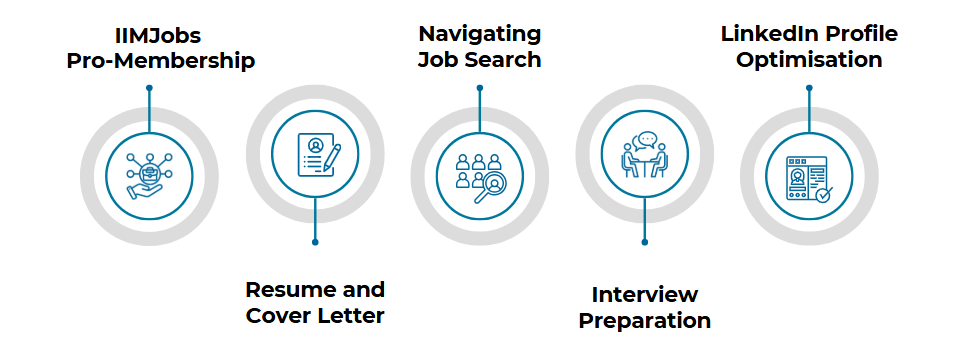
15 recorded sessions and resources in the above categories
Pro-membership and features of IIMJobs and Hirist: Access to job insights recruiter action status, follow-up actions, and ability to chat with recruiters who have shortlisted your profile
Spotlight on IIMJobs and Hirist: Profile boost for applied jobs (that align with acquired certification), greater profile visibility - highlighted with institute name along with a testimony of certificate acquisition by the candidate
Spotlight Plus: All the benefits of Spotlight and added advantages like profile and rank boost in the recruiter search database
Resume builder tool: 6-month access to DIY resume builder, auto resume creator, optimization suggestions based on key parameters, guide on information to be incorporated, and unlimited resume iterations within the duration
Notes:
These sessions are not live.
E&ICT Academy, IIT Guwahati or Emeritus do NOT promise or guarantee a job or progression in your current job. Career Services are only offered as a service that empowers you to manage your career proactively. The Career Services mentioned here are offered by Emeritus. E&ICT Academy, IIT Guwahati is NOT involved in any way and makes no commitments regarding the Career Services mentioned here.
This service is available only for Indian residents enroled into select Emeritus programmes.
Not looking for a deeply technical AI/ML programme?
Explore IIT Guwahati’s Post Graduate Certificate in Data Science and Business Analytics with Generative AI, for a focus on data science fundamentals and business applications of AI.
What is the Post Graduate Certificate in AI and ML offered by the E&ICT Academy, IIT Guwahati and who is it for?
The Post Graduate Certificate in Artificial Intelligence and Machine Learning by the E&ICT Academy, IIT Guwahati is an advanced AI course designed for professionals looking to upskill in AI and ML training. This online AI course is ideal for software engineers, analysts, business professionals, and data scientists who want to build expertise in AI and ML techniques.
Is this an online AI course, and what is the learning format?
Yes, this is a 100% online AI and ML training programme by E&ICT Academy IIT Guwahati. It includes live interactive classes, recorded video sessions, hands-on AI and ML projects, and mentorship from IIT Guwahati faculty and domain experts.
What topics are covered in this advanced AI and ML course?
The E&ICT Academy IIT Guwahati artificial intelligence course covers:
Machine Learning Training (Regression, Classification, Clustering)
AI and ML Applications in business, healthcare, and finance
AI and ML Techniques for model building, feature engineering, and hyperparameter tuning
Deep Learning, Neural Networks, and NLP
Data Science and AI-driven Decision Making
Does the course include practical AI and ML projects?
Yes, the E&ICT Academy IIT Guwahati AI course emphasizes hands-on AI and ML projects where participants work with real-world AI and ML tools like TensorFlow, PyTorch, and Scikit-learn to solve industry problems.
What AI and ML tools will I learn during the programme?
This AI and ML training programme provides hands-on experience with:
Python, Jupyter Notebooks & Data Visualization
Machine Learning Algorithms & Deep Learning Architectures
TensorFlow, Keras & PyTorch for AI Model Development
AI and ML Applications in NLP, Computer Vision, and Predictive Analytics
Cloud-based AI and ML Tools for Deployment
Will I receive an AI and ML certification from IIT Guwahati upon completion?
Yes, upon successfully completing this machine learning certificate programme, you will receive an AI and ML certification from the E&ICT Academy, IIT Guwahati, a credential recognised across industries.
How does this course compare to other artificial intelligence certifications?
The E&ICT Academy, IIT Guwahati artificial intelligence certification offers:
Expert AI and ML training from IIT faculty
Practical AI and ML projects for hands-on learning
Industry-relevant AI and ML applications
Recognition from IIT Guwahati, one of India’s top institutions
Are there any prerequisites for enrolling in this AI and ML training programme?
No prior experience in AI or ML is required. However, basic knowledge of Python programming, statistics, and data science concepts will be helpful. The E&ICT Academy, IIT Guwahati machine learning course is designed for both beginners and professionals.
How will this course help me advance my career in AI, ML, or data science?
This E&ICT Academy, IIT Guwahati AI and ML certification programme prepares you for roles such as:
AI/ML Engineer
Data Scientist
Machine Learning Specialist
AI Researcher
Business Analyst with AI Expertise
Completing this artificial intelligence certification enhances your resume and career prospects in AI and ML applications across industries.
What is the course duration, fee structure, and enrolment process?
The E&ICT Academy, IIT Guwahati AI and ML course runs for 11 months, offering flexible learning options. Detailed fee structure and enrolment information can be found on the official course page.
Early registrations are encouraged. Seats fill up quickly!
Flexible payment options available.
Starts On